Get occasional email updates on new AI tools. No spam.
AI isn't a two-horse race. 35 major labs across 12 countries are building the future. This is where we track them — organized by region, no editorial hierarchy, updated weekly.
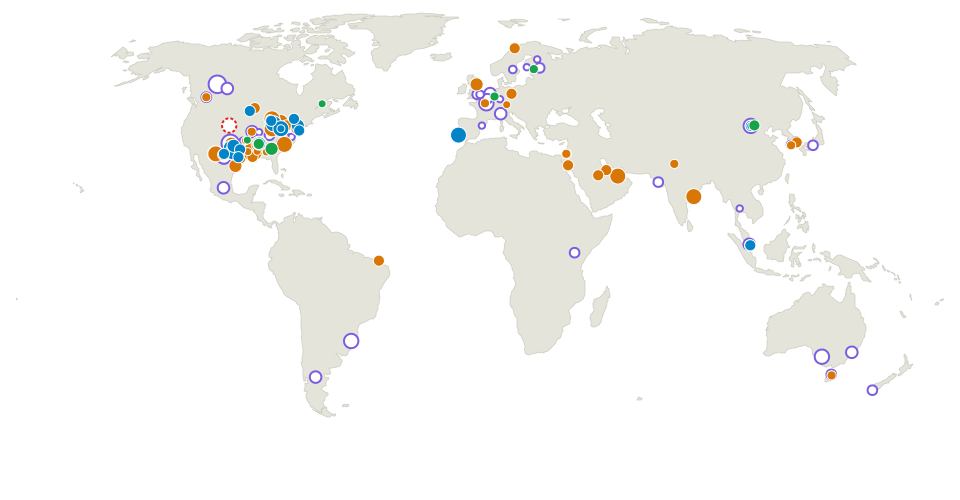
125 big AI data center sites in 27 countries: who builds them, which AI companies use them, how much power they plan, and whether they are running or still being built. Every site links to its sources.
Open the data center map →The AI industry isn't a two-horse race. We track 35 major labs across 12 countries — from Silicon Valley to Shanghai, Paris to Tel Aviv, Bangalore to Tokyo. This page organizes them by region so you can browse where you're curious. No region is "us" or "them" — they're all just labs doing interesting work at different scales.
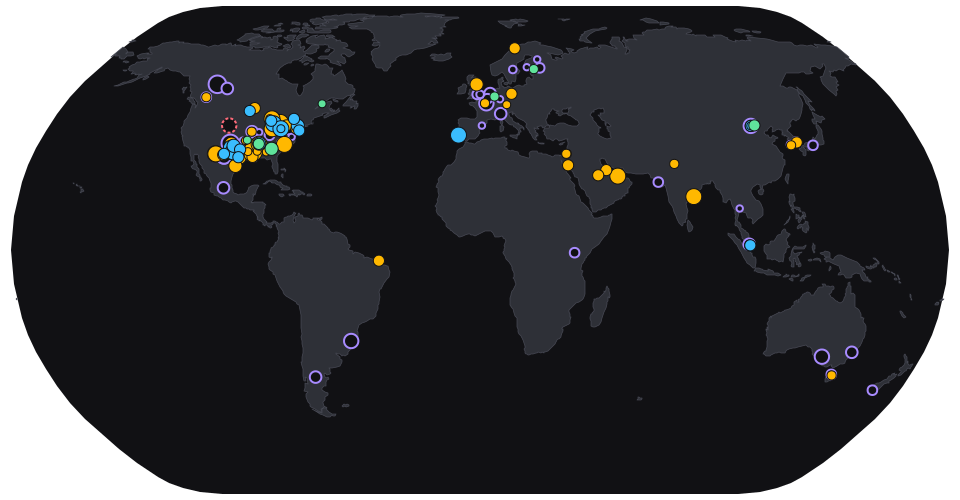
Every lab plotted on an interactive map, grouped by region.
83 companies sized by scale, colored by category — the full landscape at a glance.
One lab per region that we feature — chosen for capability, novel approach, or market impact.
The company that mainstreamed generative AI. GPT-6 Astra, released September 2026, pushes hard into agentic computer-use and coding. Distribution advantage through ChatGPT (800M+ MAU) and deep Microsoft integration.
Europe's frontier AI champion. Founded by ex-Meta and DeepMind researchers. Aggressive open-source strategy (Mistral 7B, Mixtral) made them the European response to Llama. $6B valuation, backed by Nvidia and General Catalyst.
The lab that redefined efficient scaling. Its newest model, V4.1-Flash (September 2026), has open weights and a 1M-token context window, which makes it a favorite for enterprise self-hosting.
State-backed research institute that surprised the AI world with Falcon 40B in 2023 — the first credible open-weight model from outside the West or China. Falcon 3 continues the tradition. Fully open including commercial use.
India's most funded AI startup — $41M seed round from Lightspeed and Peak XV. Building models optimized for 10+ Indian languages. Explicit thesis: India needs domestic AI infrastructure, not fine-tunes of American models.
Founded by David Ha and Llion Jones (Transformer paper co-author, ex-Google Brain). Novel research approach: using evolutionary algorithms to combine and improve existing models. Raised $200M Series A at $1.5B valuation.
Home to the frontier. Six of the ten most capable models in the world are built here. The concentration of talent, capital, and compute in the San Francisco Bay Area remains without parallel — but the moat is narrowing.
The company that mainstreamed generative AI. GPT-6 Astra, released September 2026, pushes hard into agentic computer-use and coding. Distribution advantage through ChatGPT (800M+ MAU) and deep Microsoft integration.
Founded by ex-OpenAI research leads. Claude has become the developer-favorite model for writing quality, coding, and long-context reasoning. Safety-focused positioning attracts enterprise buyers.
Merged Google Brain and DeepMind in 2023. Its newest flagship, Gemini 4 Argon, is rolling out first to trusted cyber defenders. Unique combination of research depth (AlphaFold, AlphaGo lineage) and Google's data + compute scale.
Built the Llama family that made open-weight AI mainstream. Its newest frontier model, Muse Spark, is closed-weights; the open-weight line continues with Muse Glimmer 30B (Apache 2.0).
Elon Musk's AI lab. Trained on the largest single GPU cluster in the world (Colossus, 100K+ H100s in Memphis). Distinctive positioning around 'truth-seeking' and X platform integration.
Enterprise-focused AI lab founded by ex-Google Brain researchers. Command A+ (May 2026) is an open-weight mixture-of-experts model. Strong presence in regulated industries via Oracle partnership.
The AI-native search company. Not a foundation model lab per se — instead orchestrates GPT/Claude/their own Sonar models into a search product. $18B valuation as of 2026.
Founded by Noam Shazeer (Transformer paper co-author). Consumer character-chat app that popularized AI companions. Google took a $2.7B licensing deal for their models and hired the founders back.
Building AI agents that operate software the way humans do. Founders and core team acqui-hired by Amazon in 2024, but the tech continues at Adept. Focus on enterprise workflow automation.
Founded by Mustafa Suleyman (DeepMind co-founder) and Reid Hoffman. Team and IP largely absorbed by Microsoft in 2024 for $650M, with Suleyman now leading Microsoft AI. Pi consumer app continues.
Europe's AI ecosystem is stronger than the media narrative suggests. Mistral has become a serious open-source frontier lab. Google DeepMind's London office ships some of the most important research in the field. The talent depth is real — the missing piece has historically been capital.
Europe's frontier AI champion. Founded by ex-Meta and DeepMind researchers. Aggressive open-source strategy (Mistral 7B, Mixtral) made them the European response to Llama. $6B valuation, backed by Nvidia and General Catalyst.
Founded by senior ex-Google DeepMind researchers (Karl Tuyls, Laurent Sifre, Julien Perolat). Raised $220M seed — largest in French history — on the vision of general-purpose AI agents. Product ships in 2026.
Germany's answer to sovereign AI. Focused on European enterprise and government sectors. Explainable AI approach with strong multilingual European language support. Backed by SAP and Bosch.
The lab that democratized image generation. Stable Diffusion (2022) triggered the open-source generative AI wave. Post-restructuring under new leadership, refocusing on media and enterprise generative tools.
The gold standard for AI voice synthesis. Founded by Polish researchers based in the UK. Approaching $6B valuation in secondary market. Voice quality is genuinely indistinguishable from human in most languages.
Focused exclusively on code generation and software engineering AI. Founded by ex-GitHub Copilot team. Raised $500M Series B in 2024. Deep enterprise deployments with major banks and defense.
China's AI ecosystem is the second-largest in the world by capital, talent, and model output. Chinese labs have led on open-source efficiency (DeepSeek), consumer scale (Doubao, 200M+ MAU), and specific capabilities like long context (Kimi). Under-covered in English-language media. Looking for China's humanoid-robot makers (Unitree, AgiBot, UBTech)? See Robots & Wearables → China.
The lab that redefined efficient scaling. Its newest model, V4.1-Flash (September 2026), has open weights and a 1M-token context window, which makes it a favorite for enterprise self-hosting.
China's most ubiquitous open-source model family. Dominates Southeast Asian enterprise. Default fine-tune target for Asian-language tasks.
Consumer favorite in China. Kimi K3 (July 2026) has a 1M-token context window and open weights under a custom license. Backed by Alibaba, Tencent, Sequoia China.
Spun out from Tsinghua University. Strongest showing in Chinese government and state enterprise contracts. Recent $400M round pushed valuation past $3B.
Strongest voice and multimodal player in Chinese AI. Talkie app has 30M+ global MAU. M3 (June 2026) offers up to 1M tokens of context and open weights.
Founded by Kai-Fu Lee (former Google China president). Notable for strong English performance among Chinese labs — genuine bilingual foundation models.
200M+ MAU inside China — the largest AI chatbot in the country by usage. Deep integration with TikTok/Douyin. Aggressive free tier squeezes competitors.
The original Chinese LLM. Once the leader, now working to reclaim ground. Deep integration with Baidu Search gives it distribution advantage.
Distribution through WeChat gives Hunyuan a captive audience of 1B+ users. Recently open-sourced T2, joining the open-weights race.
Originally computer vision leader, pivoted to LLMs. SenseChat 6 competitive on Chinese benchmarks. Publicly traded (HKG:0020). Heavy government sector focus.
The Middle East is spending its way to AI relevance. UAE and Saudi Arabia have committed over $100B combined to sovereign AI initiatives. Falcon (from Abu Dhabi's TII) proved the region can ship credible open-weight foundation models. G42 has become a major infrastructure and application player.
State-backed research institute that surprised the AI world with Falcon 40B in 2023 — the first credible open-weight model from outside the West or China. Falcon 3 continues the tradition. Fully open including commercial use.
The world's most capable Arabic-language LLM. Bilingual Arabic-English foundation model developed jointly by MBZUAI, G42, and trained on Cerebras hardware. Powers government and enterprise Arabic AI across MENA.
UAE sovereign AI conglomerate. $1.5B Microsoft investment in 2024 solidified strategic partnership. Operates massive compute infrastructure, healthcare AI, and financial AI subsidiaries across the region.
India's AI ecosystem is at an inflection point. Government-backed initiatives (India AI Mission, $1.2B) and private capital are fueling a wave of foundation model startups focused on Indian languages. The bet: 22 official languages spoken by 1.4B people is a genuinely differentiated market.
India's most funded AI startup — $41M seed round from Lightspeed and Peak XV. Building models optimized for 10+ Indian languages. Explicit thesis: India needs domestic AI infrastructure, not fine-tunes of American models.
India's first AI unicorn ($1B valuation in 2024). Founded by Bhavish Aggarwal (Ola CEO). Multilingual model supporting 22 Indian languages. Consumer chatbot plus enterprise API. Building own AI chips.
Reliance's AI initiative for their 470M user Jio telecom platform. Backed by parent conglomerate's scale (India's largest company). Partnership rumors with Nvidia for major AI infrastructure buildout. Product launches expected 2026.
East Asia's other AI powers. Japan and Korea have historically strong AI research (particularly in robotics and consumer applications) but have been late to LLM development. That's changing — Sakana's evolutionary approach is genuinely novel, and Korean labs are shipping strong Korean-language models.
Founded by David Ha and Llion Jones (Transformer paper co-author, ex-Google Brain). Novel research approach: using evolutionary algorithms to combine and improve existing models. Raised $200M Series A at $1.5B valuation.
Korea's most capable Korean-language LLM. Built by Naver (Korea's Google-equivalent) on custom infrastructure. Powers Naver Search, Naver Cloud, and enterprise deployments across Korean chaebols.
LG's dedicated AI research division. EXAONE models focus on scientific and enterprise applications. Notable for bilingual Korean-English performance and integration across LG's consumer electronics and enterprise software.
Every AI lab we track, sorted A-Z. Click any row to jump to that lab's region section.
35 labs across 6 regions, plotted on a world map. Pin size tracks how many labs are based there — click a pin to jump straight to that region's full list.
Every company sized by estimated scale, colored by what it builds, grouped by country — in the spirit of a stock-market sector map. Click any tile for a full summary.
See the full Chips page → Rules and supply numbers change often. Analyst estimates and “reported” items are not confirmed by the companies or governments involved. This is a summary of public reports, not legal or investment advice.